
The Shema Was Never Teaching a Lonely God
Jun 03, 2026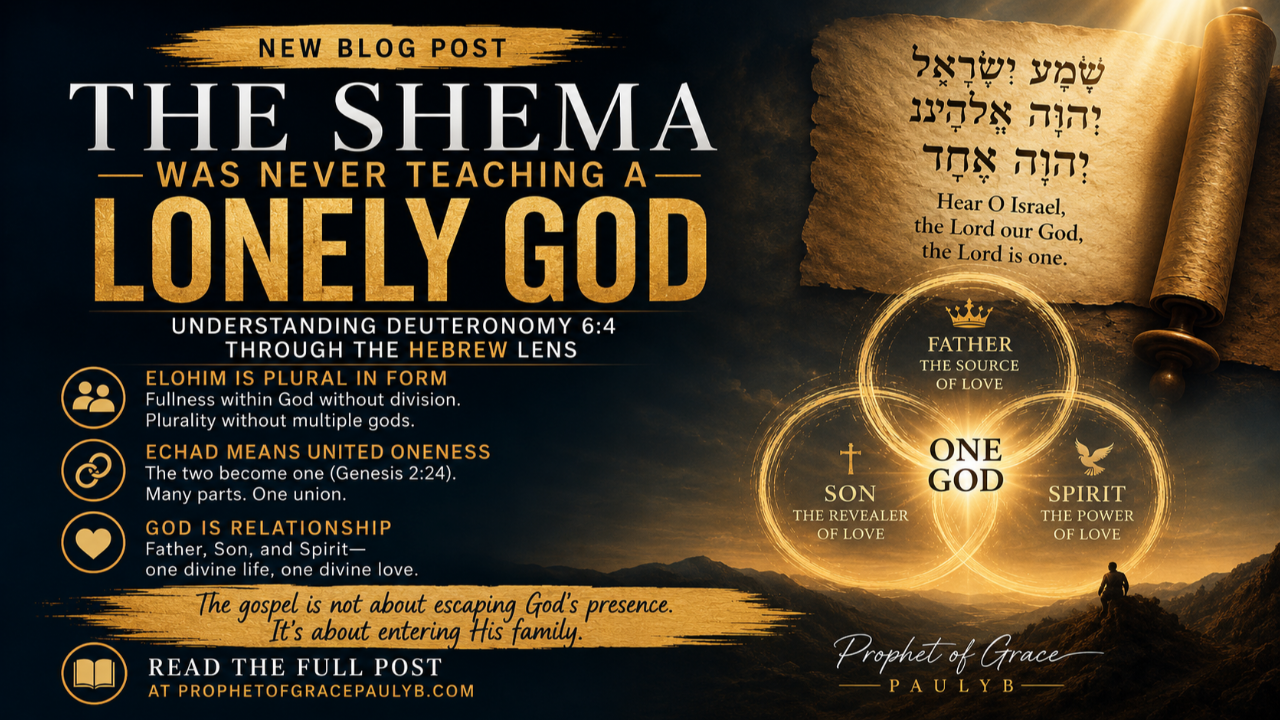
The Shema Was Never Teaching a Lonely God
By Prophet of Grace PaulyB
When most people read the Shema, they read it through a modern Western lens instead of the Hebrew world Jesus lived in.
“Hear O Israel, the Lord our God, the Lord is one.”
For years, many have assumed this verse was teaching a mathematical singularity about God, as if Moses was saying God is a solitary individual existing alone. But that is not how the Hebrew mind heard this passage.
The Hebrew language itself opens a much deeper mystery.
The word used for God is “Elohim.”
Not “El.”
Not “Eloah.”
But “Elohim.”
Elohim is a plural word.
Hebrew scholars know this immediately because the “im” ending is the normal masculine plural ending in Hebrew. The fascinating thing is that this plural noun is consistently used with singular verbs when speaking about the God of Israel.
In other words, the Hebrew Scriptures present a God who is somehow beyond human categories. There is distinction within God without division. Fullness without fragmentation. Relationship without separation.
This is why the ancient Hebrew mind was often more comfortable with mystery than modern religious systems are.
The Shema was never trying to reduce God into a lonely singular being. It was declaring that Yahweh alone is God and that He is utterly unique compared to the divided and competing gods of the nations.
Then we come to the word “one.”
The Hebrew word is “echad.”
This is important because “echad” does not always mean absolute solitary singularity. More often, it speaks of united oneness.
Genesis says:
“The two shall become one flesh.”
That word is “echad.”
A husband and wife are not erased into one person. They remain distinct persons living in union.
We see the same idea throughout Scripture:
one cluster of grapes
one people
one nation
Many parts.
One union.
The Hebrew understanding of oneness was deeply relational.
This is why the revelation of Father, Son, and Spirit should not feel foreign to the Hebrew Scriptures. The New Testament did not invent relational fullness within God. Jesus revealed what had always been true from the beginning.
John says:
“No one has seen God at any time. The only begotten Son, who is in the bosom of the Father, He has declared Him.”
Jesus did not come to introduce a new God.
He came to reveal the Father humanity had misunderstood.
From the very beginning, God was never a lonely being needing creation to satisfy emptiness. God has eternally existed in divine fellowship, divine joy, divine communion.
Father loving Son.
Son loving Father.
Spirit proceeding in the fellowship of divine life.
God is not isolated power.
God is living relationship.
This changes everything about salvation.
Salvation is not primarily about escaping punishment someday. It is about being brought into the relationship Jesus has always shared with the Father in the Spirit.
Jesus did not merely come to improve your behavior. He came to include humanity inside His fellowship with the Father.
This is why Jesus prayed:
“That they may be one, just as We are one.”
Notice that word again.
One.
Not sameness.
Union.
The gospel is participation in the life of God.
The Trinity is not a math problem to solve. It is the revelation that at the center of reality is self-giving love, shared life, and eternal communion.
And humanity was created for inclusion in that love.
The Shema was never denying this mystery.
It was protecting Israel from idolatry while pointing toward the beautiful truth fully revealed in Christ:
there is one God, and this one God is a living fellowship of love.
The Father is not the Son.
The Son is not the Spirit.
Yet God is one.
Not divided.
Not fragmented.
Not competing personalities.
One divine life.
One divine nature.
One divine love.
This is why Jesus could say:
“If you have seen Me, you have seen the Father.”
Jesus is the perfect revelation of what God has always been like.
Not distant.
Not violent.
Not separated from humanity.
But a Father who has always desired union, communion, and participation with His children.
The more we read Scripture through the mind of Christ and the Hebrew world He spoke from, the more we begin to see that the Bible was never moving toward separation.
It was always moving toward revelation:
God bringing humanity into His circle of life and love through Jesus Christ.